PILLAR ONE · TRAINING CURRICULUM

Most bartender training manuals fail at one of three points. They cover the content but lack the documentation structure. They document the training but do not integrate responsible service throughout. They integrate responsible service but do not tie the training to enforceable accountability. A manual that fails at any of these points is worse than no manual at all because it creates a documented standard the operation cannot meet.
This guide covers how to build a bartender training manual that holds up operationally, legally, and commercially. The framework below applies whether you are writing from scratch or evaluating an existing document. It is drawn from 20+ years of building training programs for bars, restaurants, and hotels, and from the specific documentation patterns that survive scrutiny in dram shop and alcohol service negligence matters.
The first decision is what the manual is. Specifically, three questions need answers before any content is drafted:
Answering these scope questions shapes everything that follows. A single-venue operational training manual is a different document than a multi-unit training and HR manual, and trying to build one document that serves both purposes usually produces a document that serves neither.
Most training manuals are structured like textbooks — product knowledge, then procedures, then policies. This structure is comfortable to write and impossible to use. Bartenders do not encounter their work in textbook order. They encounter it in shift order.
A defensible structure organizes content around how work actually happens:
This is the structure used in The Ultimate Responsible Alcohol Service Manual. It mirrors the shift itself: you arrive, you understand the space, you do the work, you handle the transactions, you maintain responsibility throughout, and you respond when something goes wrong. Content in shift order lands better than content in textbook order.
The most important structural decision is where responsible alcohol service lives in the manual. The wrong answer is to put it in a single chapter. The right answer is to weave it through every relevant section.
Practical integration examples:
Siloed responsible service training produces siloed thinking. A bartender who learns pour standards and responsible service as separate topics will treat them as separate during a shift. A bartender who learns pour standards as a responsible service tool will treat them as integrated. The second pattern is the one that produces defensible service.
A training manual is training content. The manual itself is not the full training program. The full program includes the acknowledgement forms, training logs, competency assessments, and incident reports that convert the manual from educational content into operational evidence.
Build the manual with documentation hooks in mind:
This is covered in detail in the Training Documentation pillar. The manual and the documentation infrastructure are two halves of the same program.
Alcohol service is regulated at the state level. A defensible manual handles state-specific content in one of two ways:
Do not include generic ‘state regulations vary’ language without specifying the actual regulations that apply. Generic treatment creates documentation that says nothing, which is functionally worse than no content at all. Every deployed manual should specify the state’s legal drinking age, the state’s server certification requirements, the state’s hours of sale, the state’s dram shop framework, and any other regulatory specifics relevant to daily operations.
The manual has three audiences with different needs:
Writing for all three requires balanced voice. Overly casual content loses the external reviewer. Overly legalistic content loses the new hire. The target is operational clarity with appropriate precision — clear enough to be read, specific enough to be defensible.
A manual is not static. Regulations change. Industry standards evolve. Incidents reveal gaps. A defensible manual is also a maintained one.
Build in maintenance from the start:
Before a manual is deployed, qualified legal counsel should review it. The review addresses:
Legal review is not optional for a manual that will be deployed across multiple employees and potentially surface in litigation. The cost of review is minimal compared to the cost of discovering a problem after deployment.
The above framework is what it takes to build a defensible manual. It is substantial work — typically 100–200 hours of operator time to produce the first version, plus legal review.
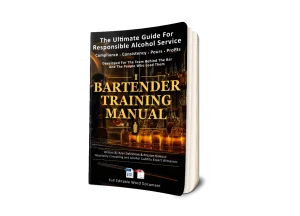
For operators who want the destination without the journey, The Ultimate Responsible Alcohol Service Manual is the complete, drafted, customizable manual. It is structured exactly as described above. It is designed to be adapted for specific venues by replacing [COMPANY NAME] placeholders and adding jurisdiction-appropriate regulatory content. It is the execution layer.
Operators building from scratch use this framework. Operators buying the destination use the manual. Both are defensible. The choice is time versus money.
Bartender Training Curriculum →The underlying curriculum framework
Bartender Training Manual Template →What a template should include
Training Documentation Pillar →The documentation infrastructure
Bartender Training Checklist →Practical checklist with downloadable template
Ryan Dahlstrom
Author & Expert Witness
20+ years of hospitality operations. Author of The Ultimate Responsible Alcohol Service Manual and The Bar Starts Here.
140 pages · 23 chapters
A one-page editable outline of the four-phase framework. Adapt it for your venue.
The Ultimate Responsible Alcohol Service Manual is the complete, drafted, customizable execution layer for the framework above.