BARTENDER COMPETENCY · SKILLS TEST

A bartender skills test verifies practical capability — what the bartender can actually do under real or simulated conditions. This page covers the practical elements of a skills test, how to administer it, and how to document the results. It complements the competency scorecard (which captures the full evaluation) by focusing specifically on the skill-domain assessment.
A complete bartender skills test integrates three components, each assessing a different layer of capability:
Brief written or oral quiz on that day’s menu, specials, pour standards, and any updates since last certification.
The bartender works a defined shift under evaluation. The centerpiece of the test — where five domains of practical capability are observed.
Evaluator walks through specific decisions and actions observed during the shift. Surfaces judgment-level competency.
The full test typically takes one complete shift (3–6 hours depending on venue) plus approximately 30 minutes of pre and post assessment. Less than that produces a thinner record; more than that consumes operational time without proportional gain.
Brief verification that the bartender has current knowledge before the shift begins:
The evaluator observes a full shift, structured around five performance domains. Each domain has specific observation points the evaluator scores against:
The liability domain
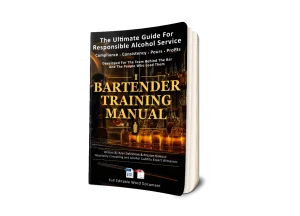
The Ultimate Responsible Alcohol Service Manual contains the skills test framework alongside the competency scorecard, written assessment, and post-shift review template — the full infrastructure to run defensible certification.
After the shift, the evaluator and bartender review specific moments together:
The post-shift review is where judgment-level competency gets assessed. A bartender who performed fine during the shift but cannot articulate why they made specific decisions may have been lucky rather than trained. The review surfaces the difference.
Results are scored on the competency scorecard. The signed scorecard, combined with the written assessment score, produces the certification determination.
Bartenders who do not pass the initial skills test enter targeted remediation addressing the specific deficits. Re-testing occurs 1–2 weeks after remediation. A bartender who fails re-testing does not work independently in a role requiring the failed skill — this is an HR decision about viability, not an extension of the testing process.
Initial skills testing establishes a baseline. Ongoing evaluation verifies continued competency at four predictable triggers:
Bartender Competency Pillar →The full competency framework
Bartender Competency Scorecard →Complete scoring rubric
Training Documentation Pillar →The documentation framework
Ryan Dahlstrom
Author & Expert Witness
20+ years of hospitality operations. Author of The Ultimate Responsible Alcohol Service Manual and active dram shop expert witness.
ASetup & Preparation
BActive Service
CResponsible Service
DArea Maintenance
EClose-Down
Test framework · scorecard · documentation
The Manual contains the complete skills test framework, observed-shift rubric, post-shift review template, and certification record — the infrastructure that turns observation into evidence.